
From Laboratory to Industry: Scaling up Advanced Coatings
- October 21, 2026
Advanced coating technologies continue to attract strong scientific and industrial interest because of their ability to improve durability, efficiency, and sustainability across a wide range of sectors. Thermal spray coatings, in particular, are increasingly used to protect industrial components exposed to wear, corrosion, high temperatures, and demanding operating conditions. [1] However, developing a promising coating in the laboratory is only the beginning of the innovation journey. The transition from experimental research to reliable industrial application remains one of the most challenging stages in advanced materials development. [2]
A coating that demonstrates excellent performance under controlled laboratory conditions must also prove that it can be produced consistently, applied reliably, perform under realistic operating conditions, and provide sufficient economic and environmental value. [3] Scaling up advanced coatings therefore requires the integration of materials science, process engineering, industrial validation, and data-driven decision-making to bridge the gap between bench-scale breakthroughs and commercial viability.[2, 3]
The challenge of scaling up advanced coatings

Laboratory-scale coating development typically takes place under carefully controlled conditions. Researchers can optimise parameters such as material composition, powder characteristics, spray distance, particle temperature, substrate preparation, and deposition conditions. Industrial environments are considerably more complex. Changes in component geometry, equipment configuration, production rates, environmental conditions, and operating parameters can influence coating quality and reproducibility. For thermal spray technologies, factors such as particle velocity and temperature, powder feed rate, spray distance, substrate condition, and process atmosphere can affect the resulting coating microstructure and properties. Small variations can influence characteristics such as porosity, adhesion, hardness, wear resistance, and corrosion behaviour. Industrial validation must therefore go beyond demonstrating that a coating works on a laboratory specimen. It requires testing under representative conditions and assessing whether the coating can deliver consistent performance across realistic components and production environments.
From laboratory results to industrial validation
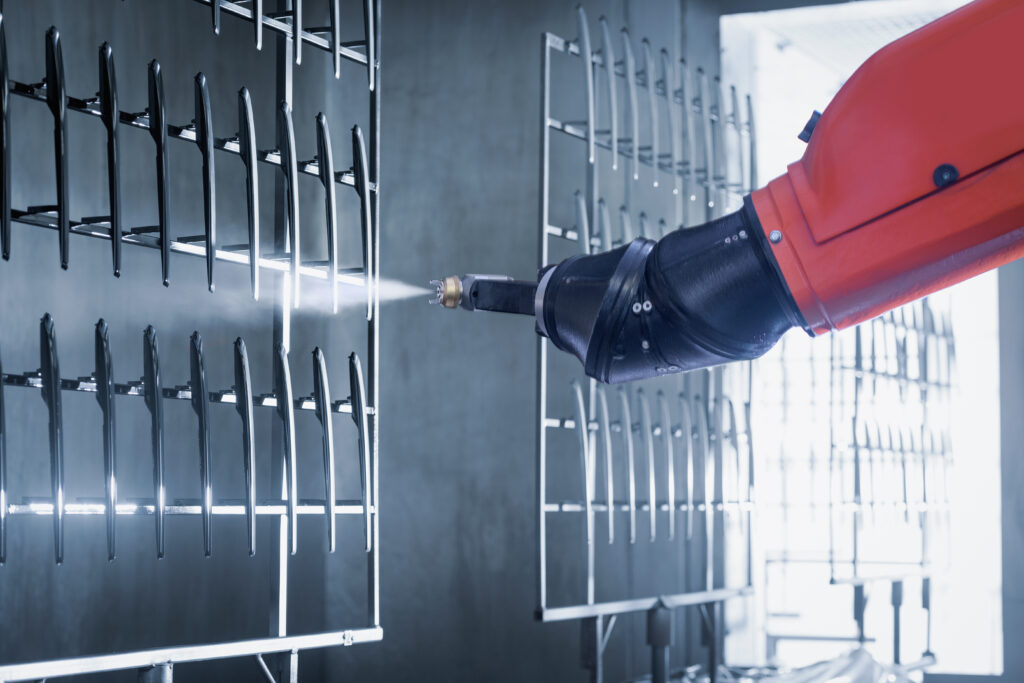
Successful scale-up involves a progressive transition from laboratory experiments to pilot-scale and industrial demonstrations. Pilot trials allow researchers and industries to investigate how coating materials and deposition processes behave when production conditions become more demanding. They can also reveal practical limitations that may not be visible during laboratory development. Performance testing is an essential part of this process. Depending on the application, coatings may need to be evaluated for wear, corrosion, adhesion, thermal stability, mechanical loading, or resistance to repeated operating cycles. At the same time, industrial users need to consider factors beyond technical performance. Equipment compatibility, process duration, material availability, maintenance requirements, production throughput, and cost can all influence whether a new coating technology is realistically adoptable. The successful scale-up of advanced coatings therefore requires close interaction between research organisations, coating developers, equipment manufacturers, and industrial end users. [1]


The role of data and digital technologies
The increasing complexity of coating development is also creating new opportunities for computational and data-driven approaches. Modern thermal spray research generates large amounts of information from material characterisation, process parameters, experimental testing, modelling, and performance evaluation. Artificial Intelligence and Machine Learning can help identify relationships within these datasets and support process optimisation and performance prediction. Recent research has highlighted applications ranging from material development and process optimisation to coating-performance prediction, defect detection, quality control, and digital twins.[4, 5]
These approaches do not replace experimental validation. Instead, they can make the development process more efficient by helping researchers identify promising material compositions and process conditions before undertaking extensive experimental campaigns. The combination of computational modelling, experimentation, and data analysis can therefore help shorten the path between material discovery and industrial demonstration.
CoBRAIN’s approach to industrial implementation
CoBRAIN addresses this transition through an integrated computational-experimental approach to advanced coating development. The project investigates novel High-Entropy Hardmetal systems for thermal spray applications while combining materials development with computational methods, Artificial Intelligence, experimental validation, sustainability assessment, and industrial requirements.
Rather than treating material development and industrial implementation as separate stages, CoBRAIN connects them through a continuous flow of information. Experimental results can contribute to computational analysis, while industrial requirements can guide the development and evaluation of candidate coating systems. The Sustainable Decision Support System (SDSS) further supports this integrated approach by bringing together relevant technical and sustainability information to help users evaluate coating solutions according to specific application requirements. This type of integration is particularly important when moving towards industrial implementation, where decisions need to consider several factors simultaneously rather than focusing on a single material property.
Industrial and market impact
Τhe successful scale-up of advanced coatings can provide important benefits across sectors including automotive, aerospace, steel, energy, chemical processing, textiles, and manufacturing. Extending component lifetime can reduce replacement requirements, maintenance frequency, material consumption, and production downtime. At the same time, the development of safer and more sustainable alternatives can help industries respond to evolving environmental and resource-efficiency objectives. Circularity can also become part of the scale-up process. Recent research has demonstrated the potential to reuse thermal-spray overspray powder as feedstock for new coatings. In one 2025 study, the reuse of WC-based overspray was associated with reductions in energy consumption and CO₂ emissions by a factor of two to three and a three- to fivefold reduction in production costs in the investigated case. [6] Such developments demonstrate that industrial innovation increasingly needs to consider not only whether a coating performs well, but also how efficiently and sustainably it can be produced and used.

Conclusions
The transition from laboratory research to industrial application is one of the most important stages in advanced coating innovation. Technical performance alone is not sufficient to guarantee successful adoption. Reproducibility, process stability, industrial compatibility, economic feasibility, sustainability, and long-term performance all need to be considered before a new coating technology can become a reliable industrial solution.
CoBRAIN contributes to this transition by connecting advanced materials development with computational modelling, Artificial Intelligence, experimental validation, sustainability assessment, and digital decision support. The future of advanced coatings will therefore depend not only on developing better materials, but on creating a more effective pathway for turning those materials into reliable, sustainable, and industrially relevant solutions.
References
- Ang, A. et al. (2026). Innovative Coatings for a Greener Sky: The 2026 Strategic Roadmap for Thermal Spray and PVD Coatings. Journal of Thermal Spray Technology, 35, 2099-2200. DOI: 10.1007/s11666-026-02276-5
- Saylam, A. (2025). Engineering Scale-Up: Overcoming Challenges from Lab to Industry. Zenodo. DOI: 10.5281/zenodo.19767463
- Warfsmann, J. et al. (2026). Large-scale coating methods for improving heat transfer and stress management of metal hydrides. Energies, 19(10), 2451. DOI: 10.3390/en19102451
- Zhou, Y.-J. et al. (2025). Intelligent thermal spraying: A comprehensive review of innovation driven by artificial intelligence and machine learning. Materials Today Communications, 49, 113804. DOI: 10.1016/j.mtcomm.2025.113804
- Gao, H. et al. (2026). Machine learning in thermal spraying: applications, challenges, and future perspectives. Surface Science and Technology, 4, 17. DOI: 10.1007/s44251-025-00113-5
- Alroy, R.J. et al. (2025). Demonstrating circularity in thermal spraying: Converting waste to wealth. Materials Today Sustainability, 32, 101251. DOI: 10.1016/j.mtsust.2025.101251